
Blog · 30 September 2026 · 4 min read
Tiled Recently and Still a Hazy Film? How We Remove Grout & Cement Residue with Faber Products
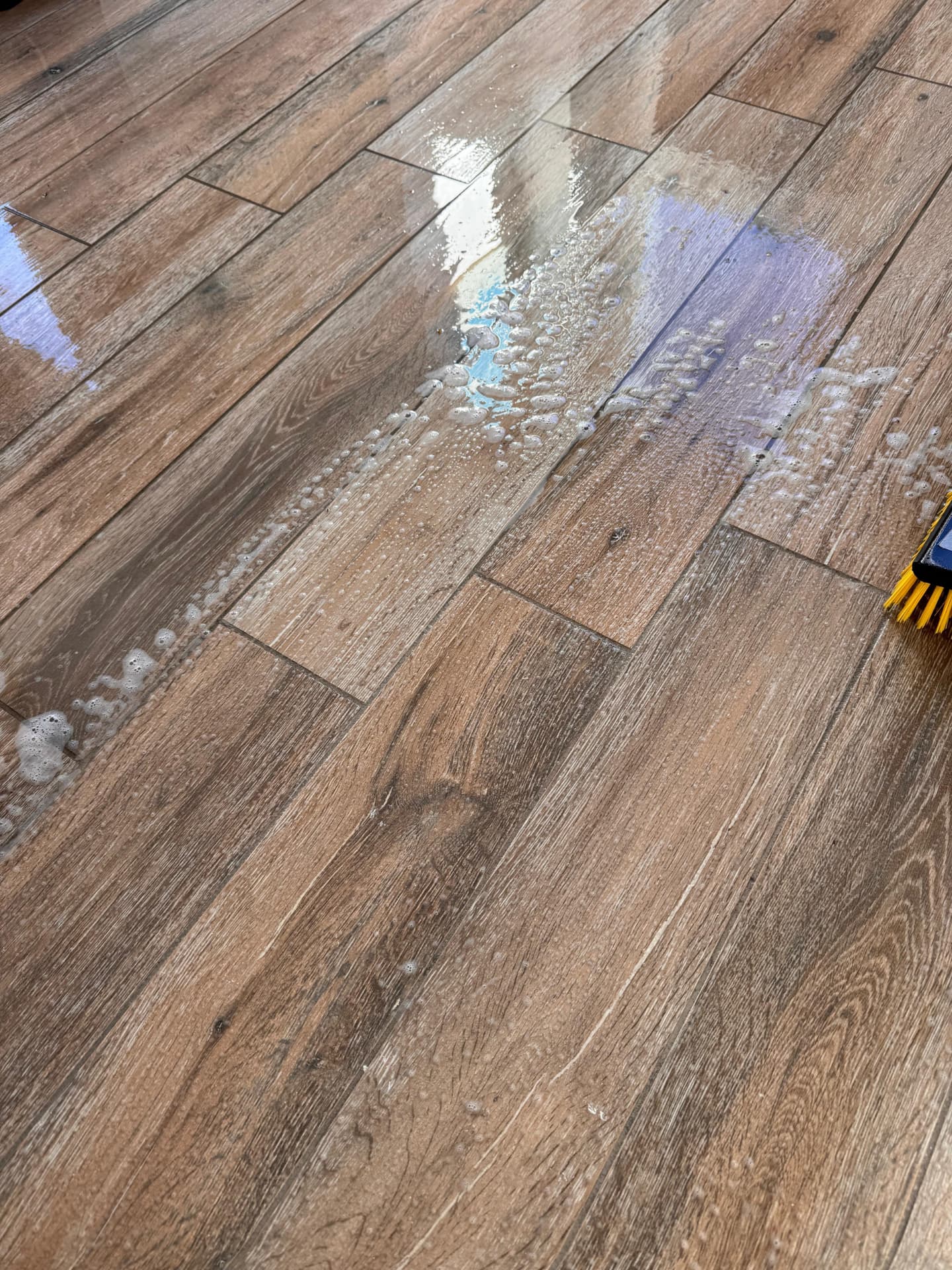
You paid for a new tiled floor. The tiler packed up, the room looked great — and then a few days later you notice it: a dull, cloudy film over the tiles, and grout lines that look smeared rather than crisp. This is one of the most common problems we're called out to, and it's almost never the tiles' fault. It's leftover cement, grout and building residue that wasn't cleaned off properly at installation.
Many residues can be removed. We use suitable Faber products — the same professional stone-care range we use on every restoration — and we follow their recommended process. Here's exactly how it works.
What that film actually is
During tiling, cement-based adhesive and grout sit on the tile face for hours. If they're not washed off as the job goes — and washed off well — they cure into a thin, stubborn haze. Add in the rest of a typical building site: plaster dust, screed splashes, tape marks and general building dirt, and you get a dull film that no amount of everyday mopping will shift. Household cleaners just move it around, and anything acidic from the supermarket can actually damage the surface underneath.
Step one: identify the residue
Not all residue is the same, and using the wrong product on the wrong film is how floors get damaged. Cement and grout haze calls for an acid-based cement residue remover. Greasy films, tape marks, wax or general builder's dirt need an alkaline cleaner instead. We always check what we're dealing with first — and we test in an inconspicuous corner before treating the whole floor.
Step two: remove cement and grout haze
For cement and grout residue, we use a suitable Faber cement-residue remover, a professional descaling cleaner designed to dissolve cured cement and grout film on compatible, acid-resistant surfaces. We do not use acidic removers on marble or limestone. The product label determines dilution, contact time and application. The process:
- Vacuum or dry-sweep the floor first so loose grit can't scratch the surface while we work.
- Apply the selected Faber cleaner at its label dilution with a mop or sprayer, working a manageable area at a time.
- Allow the contact time specified for the product and surface, without letting the cleaner dry on the tiles.
- Agitate with a scrubbing pad or machine — this lifts the haze out of the tile's texture and out of the grout lines.
- Remove the slurry and rinse thoroughly with clean water. Dirty rinse water is changed constantly; leaving it on the floor simply dries the residue back down.
Step three: remove grease and building dirt
Where the problem is a greasy or general building film — tape residue, paint flecks, wax, plaster and dirt combined — acid isn't the answer. We select a suitable Faber alkaline cleaner for the surface and residue. Paint, adhesive and wax may need a different compatible Faber treatment. We test first, follow the label, agitate carefully and remove the dirty solution. Some marks or surface damage cannot be fully removed.
A word of caution on natural stone
Porcelain and ceramic tiles handle this process well. Polished marble, limestone and other natural stones are different — the wrong descaler can etch the surface and dull the finish, turning a cleaning job into a restoration. That's exactly why we test first and choose the Faber product to suit the surface. If your "tiles" are actually natural stone, call us before anything else touches them.
Step four: assess whether sealing is useful
Once the floor is clean and sufficiently dry, sealing is optional where it suits porous grout or the surface. A suitable Faber penetrating sealer reduces absorption, but does not make grout dirt-proof or prevent every stain. Proper removal of dirty mop water still matters. For day-to-day care afterwards, stick to a pH-neutral cleaner and a well-wrung flat mop; ordinary detergents leave a film of their own (we explain why in our floor aftercare article).
Don't live with a dull new floor
If your newly tiled floor is hazy, streaky or smeared with grout lines that never came clean, that's an installation clean that wasn't finished — not a floor you have to put up with. We remove builder's residue from porcelain, ceramic and natural stone floors across Dublin, Kildare, Wicklow and Meath, usually in a single visit. And if the tiler is still on site, the cheaper fix is getting it cleaned before the dust settles — but if they're long gone, that's exactly what we're here for. For older floors where the grout has simply darkened with use, see our tile and grout cleaning service in Dublin.
New tiles stuck with a hazy film?
We remove builder's and grout residue properly — free, no-obligation quotes across Dublin, Kildare, Wicklow and Meath.